How AI Video Is Rewriting Content Marketing in 2026
Faceless channels, instant repurposing, and avatars that never sleep — here is the AI video stack I use to ship 30 days of content in an afternoon.
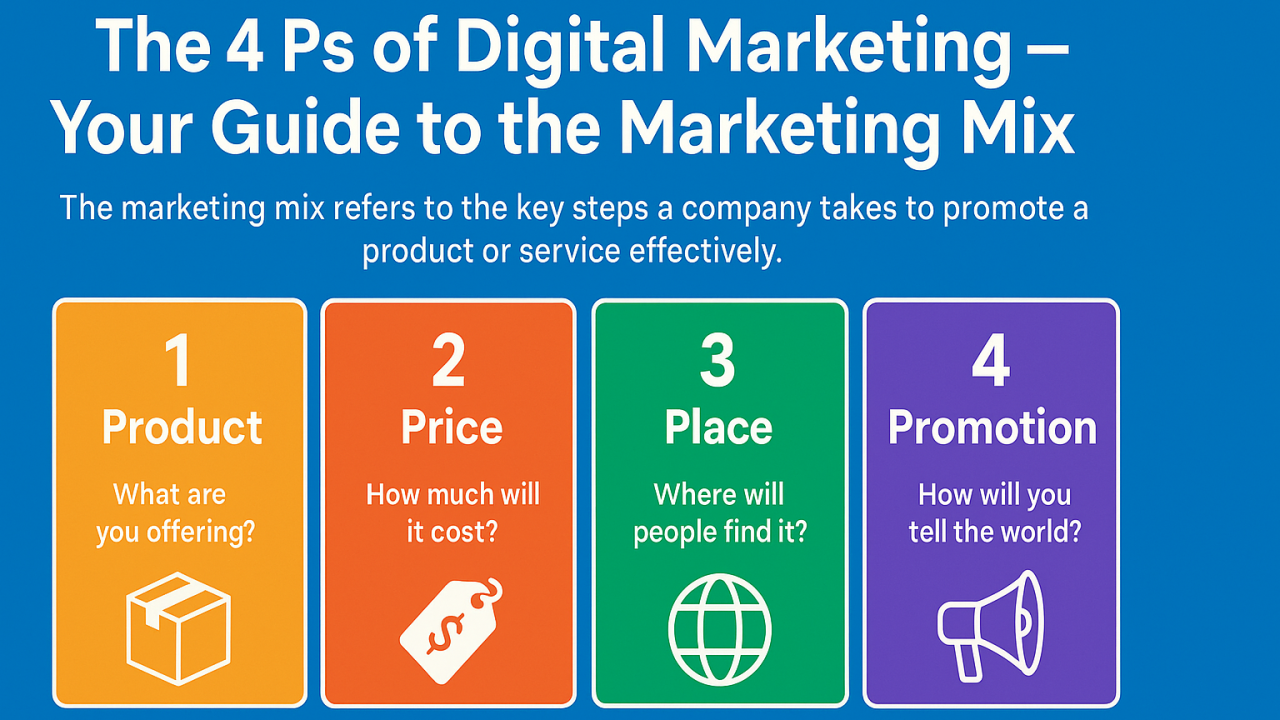
Search "digital marketing mix" and you will meet the same four letters everyone learned in business school — Product, Price, Place, Promotion. But online, those four levers behave nothing like they did in 1960. This guide rebuilds the digital marketing mix from the 4Ps up through the 7Ps and the 4Cs — with examples from the brands getting it right.
The digital marketing mix is the set of controllable levers a brand uses to attract and convert customers online: product, price, place, and promotion, each adapted for digital channels. You will also see it called the online marketing mix or simply the digital 4Ps.
The framework itself is old. Harvard's James Culliton described marketing in 1948 as a "mixing of ingredients," his colleague Neil Borden coined the phrase "marketing mix," and E. Jerome McCarthy distilled it into four Ps in his 1960 book Basic Marketing. Philip Kotler then turned it into the default language of marketing worldwide. What changed is not the recipe but the kitchen: every one of those four levers now operates in public, in real time, on a screen the customer fully controls.
Offline, the 4Ps moved slowly. A price was printed, a product shipped to shelves, a campaign ran for weeks before anyone knew if it worked. Online, all four are live and editable: prices change by the hour, products improve with a software update, and a campaign's results land before lunch.
Three shifts define the digital 4Ps. Everything is measurable — you can trace a sale to a single keyword. Everything is comparable — the customer sees you and ten rivals in one tab. And the customer is in control — they search, scroll, and skip on their own terms, so attention is earned, not bought. Critics argue the original 4Ps are too product-centric for this world, which is exactly why the model later grew into the 7Ps and was reframed as the 4Cs. We will cover both.
Online, your product is far more than the item in the box. It is the listing page, the photos from every angle, the spec table, the reviews, the demo video, and the return policy — the entire experience a customer judges before they ever touch the thing. Start with demand, not supply: understand the problem people are actually trying to solve, then shape the product and its page around that need. Digital also lets you ship updates, bundle add-ons, and personalise variants on the fly. Your product page is now a salesperson, a search result, and social proof all at once — so the sharpest move in the digital marketing mix is simple to say and hard to do: treat the product page as part of the product.
Price online is brutally visible. A customer can line you up against ten competitors in a single tab, so your number has to justify itself on sight. That makes perceived value the real battleground: raise the benefits a buyer sees or lower the friction, and your price feels fair; fail to, and the next tab wins. Digital pricing is also dynamic — you can test, segment by audience, run flash sales, and adjust by demand, region, or device. Anchoring, tiered plans, and "most popular" labels all nudge the choice. Price is no longer a sticker on a shelf; it is a live signal you tune with data.
In the digital 4Ps, "place" means the channels and platforms where the sale actually happens: your own website, marketplaces like Amazon, social commerce inside Instagram or TikTok, and in-app stores. Distribution is now half logistics and half digital shelf — being findable in search, in stock, and one tap from the cart. The old question was "which shops stock us?" The new one is "are we present at the exact moment the customer is ready to buy?" Modern buyers move across devices and channels in a single journey, so the mix has to be omnichannel by default. If you are not where your customer already shops, the other three Ps never get their turn.
Promotion is where the digital marketing mix gets crowded. SEO, paid search, social ads, email, content, influencers, affiliates, and retargeting all fight for the same scrap of attention. It helps to sort them into owned (your site and list), earned (reviews, shares, press), and paid (ads) — and to balance all three rather than rent attention forever. The advantage of doing it online is feedback: within hours you know which message, audience, and channel actually moved sales, so spend can follow evidence instead of hunches. The brands that win promotion do not shout the loudest — they show the most relevant message to the right person at the moment they are deciding.
The classic four Ps were built for selling products. Services and online experiences needed more, so the model expanded to seven by adding People, Process, and Physical Evidence — the 7Ps of digital marketing.
Every human touchpoint that shapes the experience: support agents, the founder posting on LinkedIn, the community manager replying to comments, even the reviewers vouching for you. Online, your people are your brand's voice — and customers can see exactly how you treat them in public.
How the service is delivered end to end — onboarding flows, checkout speed, delivery tracking, returns. A clumsy process leaks customers no matter how good the product is. Online, the process is a large part of the product.
The proof that you are real and reliable: a polished website, ratings and reviews, case studies, security badges, packaging, and the confirmation emails that reassure a buyer they chose well. With no physical store to walk into, these signals do the trust-building.
The 4Ps describe the business's levers. The 4Cs, popularised by Robert Lauterborn, retell the same story from the customer's point of view — a more honest lens for digital, where the buyer holds the power:
You do not have to pick one model. Use the 4Ps to audit your own levers, then run the 4Cs to check whether any of it matches what the customer truly wants.
They are not rivals; they are lenses on the same decision. Start with the 4Ps to audit the levers you control. Add the 7Ps if you sell a service or an experience, where people, process, and trust signals decide the sale. Then pressure-test everything through the 4Cs to make sure those levers line up with what the customer actually wants. Most strong digital teams keep all three in their back pocket and reach for whichever one exposes the weakest part of the plan.
The e-commerce marketing mix is where all of this compresses into a single session: the product page sells, the price converts, the platform delivers, and the promotion drove the click — sometimes inside sixty seconds. Two familiar brands show the mix working as a system rather than four separate tactics.
Amazon wins on selection and place — a near-infinite catalogue sold across its own site, third-party marketplace sellers, and even physical stores through Whole Foods — backed by dynamic pricing and sponsored-product promotion that meets shoppers at the moment of intent. Spotify shows the mix for a digital service: a freemium price (free with ads, or paid premium tiers), the app itself as the "place," and personalised playlists and recommendations doing the promotion. In both cases no single P carries the load — they reinforce each other, which is the whole point of a mix.
Netflix runs the same playbook on pure content: tiered, segment-based subscription pricing replaces a one-off sale, the streaming app is the place, and personalised recommendations plus a generous free trial handle promotion — proof the mix scales from physical goods to fully digital products.
The digital 4Ps are not four separate campaigns. They are one promise told four times — and the customer notices the instant one of them lies.
A framework is only useful if it changes what you do on Monday. Build your mix in five passes:
Most weak mixes fail the same few ways: treating the four Ps as four separate teams that never talk; obsessing over promotion while the product page and checkout quietly lose buyers; competing only on price until there is no margin left to reinvest; and copying a competitor's mix without checking whether your customer wants the same things theirs does. The mix is a system — break the system and no amount of ad spend can fix it.
The 4Ps — product, price, place, promotion — were designed for selling products. The 7Ps add people, process, and physical evidence to cover services and online experiences, where how you deliver matters as much as what you sell.
Yes. The levers have changed, not the logic. The digital marketing mix is simply the 4Ps adapted for a world where pricing, distribution, and promotion all happen on screens the customer controls.
Consumer, cost, convenience, and communication — a customer-first retelling of the 4Ps that starts from what the buyer needs rather than what the business wants to sell.
It applies the same Ps to an online store, but compresses them into one checkout flow — so product pages, pricing, platform, and promotion all have to convert within a single session rather than across separate channels.
E. Jerome McCarthy introduced the four Ps in his 1960 book Basic Marketing, building on James Culliton's 1948 "marketing mix" idea, and Philip Kotler later popularised the model worldwide.
SEO, AEO, e-commerce, social — search has splintered, but the discipline underneath has not. Get product, price, place, and promotion aligned around one positioning, extend them with the 7Ps and 4Cs where it fits, and you stop running four tactics and start running one strategy. That joined-up thinking is what we build every guide around at Marketing's Mix. Master the digital marketing mix and you do not just show up online — you show up everywhere your customer already is.
Faceless channels, instant repurposing, and avatars that never sleep — here is the AI video stack I use to ship 30 days of content in an afternoon.
No budget, no problem. These free utilities cover SEO, social previews and campaign tracking — several of them are built right into this site.
Search is no longer ten blue links. Here is how to optimise for classic SEO, answer engines, and generative AI results — at the same time.